By Trent Kimery
Transcript:
Gōdne morgen, Wes þu hāl (Good Morning, be thee hale)
Góðan morgon, Heill ok sæll (Good Morning, hale and happy)
Nart þū Hráfn fram Ribe? (Aren’t you Hráfn from Ribe?).
Ja, þat’s jak. Cædwalla frá Austr-Engla, erin ír æy? (Yes, that’s I. Cædwalle from East Anglia, aren’t you?)
þæt bēo ih. Spricst þū Englisċ? (That I am. Do you speak English?)
I do, not the best. But I speak it.
How have you been? How are you, my friend?
You sound stressed. Are you all right?
Things have been tumultuous in England in the moments.
The Welshman getting uppity again?
The Britons? Yes. Wessex and Mercia are at war with them now. Again,
Good work for the likes of me. It sounds like.
You’re a mercenary, are you not?
I am, my ship’s rigging needs replacing, and I also may have broken my sword on a Frank’s helmet. Need a new one?
Ah, the Franks, lofty folks.
I don’t recall seeing you here before. Are you one of those monks I keep hearing about in Frankia?
Ah, yes. I was born here. My parents gave me a way to a monastery when I was young. I’ve only lived there basically my entire life. Are you Christian?
No.
Ah, a pagan. Well, we are all his children. We actually began Christianizing a couple of decades ago. Redwald, the king of East Anglia; the current king is his great-grandnephew. he was Christianized first. Bede wrote about it in his book, which he published recently.
I am vaguely aware of Redwald. Some fancy helms come out of that bloodline I’ve seen. yeah.
I actually think the man behind you, helping with the rigging, is wearing a helmet that is similar, from what I’ve heard. a bit more ornate. Cheek guards, face plates, and quite intricately decorated silver. Gold boar’s head.
How was he meant to breathe through a face plate?
It might have been ceremonial, but who knows? Never met the man myself, but from what I know, Angles, Saxons, and Jutes came from near where you’re from. Do they not, my friend?
More from Jutland, but close enough. We’re kin. We’re not murdering each other, at least. Yeah, that’s. I guess it comes with the territory of being on the coast and kindred. Unfortunately, Franks are starting to shut us out of ports, which they wouldn’t do. Let’s make trading a bit hard. Shown the other ports.
Why is that?
Something about not wanting non-Christians in Christian cities and ports. And I stopped paying attention after they started mewling. Honestly, knowing how the Franks tend to treat people around them. I’m not particularly surprised. They’re fractious at best and often just start wars. Sometimes with each other, sometimes with neighbors, sometimes without reason.
Going back to Redwald, He was buried a long, long time ago at Sutton Hoo. It’s about east of here.
One of those mound burials? I think I saw one once.
A ship burial, actually. You folk do that as well, if I know correctly. But it was beautiful. Jewels. Gold, silver. Came from all over. We all travel. Information spreads. Gold spreads.
Amber fir, timber. A lot of timber. Surprising amounts of timber
Your ships are made of timber. Good wood, from what I’ve seen.
Oak. Oak. Solid. Blessed oak.
Blessed is it?
Your sword, it’s Frankish, correct, made of steel?
Aye, bought it from an armor in Frankia. Or at least claimed to be an armorer. Uh, said his name was Ulfberht, but I’m not sure I believe him on that. A lot of people claim to be Ulfberht.
Ah, yes, I’ve heard of tales of this Ulfberht, a famous armorer or something?
Something like that. But it broke, so it’s clearly not that good.
That’s a problem with relics going around as well. It’s hard to tell which is real and which is not. Relics?
Oh, it’s Christian things. Holy figures. The bits of pieces of body, clothing, or things. They owned.
You Christians are a macabre sort.
From what I’ve heard of you, Norseman. You are not so different.
Maybe, but we don’t keep bones around.
But, on the topic of the sword, you may be able to consult the armorer in port. He may be able to fashion you a new sword. May cost you a pretty penny.
Yeah, usually swords aren’t cheap, but I’d rather have one than not have one.
And potentially, maybe a new helmet for you.
What’s wrong with it? I like my helm.
Nothing, it looks worn, that’s all, my friend.
It has character. I once headbutted a man with it.
Ah, so you did.
I do need some repairs to my ship while I’m here, though. The hull’s been a bit beat up. Besides, from the rigging, the sails are a little torn. We got caught in a storm and thrown off course. Ælfwald, I believe, is the reigning Lord here, correct?
Ælfwald yes. He is the great-grandnephew of Redwald, in fact, his brother. Ealdwulf reigned before him. He may be able to get you mercenary work.
Expecting wars to happen soon?
Potentially.
Do tell.
Not with us, but you may, they may get you in contact with the Mercians or Wessex, their little spat with the Britons, if you feel that is your fancy. I could see if I can contact the bishop. He has his ear to the council. The Witan. It’s made up of local aristocracy, bishops, earls, and thegns.
It’s a moot. I know what a moot is.
Ah, it’s a council where you are from?
It’s close enough.
Ah, yes. We are more similar than we are different.
So your current reigning liege is the brother of the last one?
No, the great-grand nephew. His father was the brother of Redwald. Redwald passed ages ago.
Got it. Complicated bloodlines. I don’t deal with royalty too much. Or nobility.
It’s a whole dynasty that has existed for at least two centuries, I would say.
Longer than I care to keep track of. To be honest, or should I say to be frank. I’m very funny.
Well, these repairs are going to take a while. I tell you what. How about you and me go to the local thegn? He may be able to point you to the armorer, and then he may have to be able to point you to where some mercenary work is. And I’ll leave you there and then go to the local bishop and see if he can get you in contact with the king. Does that sound fair, my friend?
Is the bishop your Christian goði?
Yes. In a sense, it’s more complicated than that. bishops, archbishops, deacons, and priests. The pope, of course, but he’s all the way in Rome, which I haven’t heard about him in a while. But word takes a long time to travel.
I’ll speak to this, thegn, you called it. Yeah. Thegn.
I think hersir would be the closest equivalent.
Is it similar to your huscarl?
No, it’s closer to hersir. Huskarl is less politically inclined, usually, and more axe inclined.
A man of combat.
A man of drengskapr, but the same thing.
I’ll pretend I know what that means.
You do that well.
Shall we get going then?
Aye, I have a ship to fix. And my men need to be intoxicated before I can start yelling at them.
Well, the ale is pretty good here. So you may find that.
Do you make it?
Uh, yes, yes, we do.
That explains a lot. Off we go.
Blog Post:
Sutton Hoo: Vendel Era Trade and Culture
The scene takes place in 745 CE at a trading port in the kingdom of East Anglia and follows two figures. The first is an East Anglian monk by the name of Cædwalla, who is visiting the port; the second character is a Norse mercenary named Hráfn, who is standing in front of a damaged longship and is getting local news from Cædwalla since he’s been out at sea for a good long while. He is considering working for a local earl. Not only is this a fun and immersive experience, but also realistic as Bede makes mention of King Raewald of East Anglia (c. 599 – c. 624), with whom the Sutton Hoo Ship Burial and Helmet is associated. The monk would most likely have read Bede’s work and would know of Raewald, as the current king of East Anglia, Ælfwald (713-749), is the great grandnephew of Raewald, allowing him to represent and delve into the intellectual travel, while the Norse mercenary is a traveller, and so the two would be able to converse on topics of trade, travel, politics and a shared material culture.
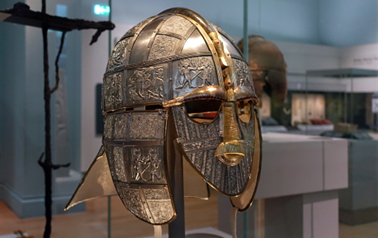
The Sutton Hoo Ship Burial, located in Suffolk, England, is a treasure trove of information about the material and trade culture of the Anglo-Saxons and early Nordic cultures during the Vendel Era. For clarification, the Vendel Era was a precursor to the Viking Age, serving as a intermediate period between the Migration Period and the Viking Age in Swedish prehistory Believed to be dedicated or associated with the East Anglian king, Raewald or Redwald, as the Venerable Bede writes his name, the ship burial contains a plethora of objects, including a sword, a golden belt buckle, a purse lid, silver and gold coins, a shield, and the topic of this blog post, an ornate helmet. Now, the helmet itself had to be reconstructed, as at some point the roof of the burial chamber had collapsed, shattering the helmet into hundreds of tiny pieces. It was reconstructed twice based upon new research that had been released; the first was in 1946, with it then being reconstructed a second time, and the current iteration in 1971.
What is truly remarkable about the helmet, besides the ornate and beautiful designs depicting warriors, animals, and even a human face, is the helmet’s design and its striking similarity to similar helmets found in excavations at Valsgärde in the Uppland region of Sweden. For reference, the distance from Valsgärde to the Sutton Hoo Ship Burial is around 818 miles or 1,317 km away.
The similarities in design of the helmets recovered from Valsgärde and the second reconstructed iteration of the Sutton Hoo helmet are astounding, but also reflect a shared material culture, which isn’t very surprising when one examines the origins of the people known as the Anglo-Saxons. The people and culture that historians and the general public now call the Anglo-Saxons would not have identified themselves as such, as the concept of a unified proto-national/cultural identity is a modern concept that emerged in the 19th century. Rather, individuals tended to identify themselves based upon shared cultural or perceived kinship, often associating themselves with either the family unit, chieftain, or other local leader, rather than a unified group.
In fact, the Anglo-Saxons were once two separate Germanic tribes known as the Angles and the Saxons, both of whom were originally located in what is now Lower Saxony and Schleswig-Holstein of modern-day Germany. This would place the Angles and Saxons in proximity with the Danes, Geats, and Swedes, explaining the striking similarities in the material culture of the Anglo-Saxons and Scandinavia, as they are both culturally Germanic. Now, the Angles and Saxons migrated to the British Isles, known in their time as Britannia, around the 4th to 8th centuries during a period known as the Migration Period.

It is this history of the so-called “English People” that an 8th-century Northumbrian monk and scholar known as Bede, or the Venerable Bede, writes about in his book called Historia ecclesiastica gentis Anglorum, better known in English as The Ecclesiastical History of the English People. While written with a flagrantly pro-Christian, pro-Anglo-Saxon bias, as seen by Bede’s frequent slander of the native Britons (Welsh), Bede’s work nevertheless describes the history of Britannia starting from the invasions of Britain by Caius Julius Caesar in 55 BCE and 54 BCE, ending with the death of Archbishop Bertwald in 731 CE. However, it is in book two that is of particular interest to the subject of this blog post, that being the mention of one King Redwald of East Anglia in a list outlining the political landscape of seventh-century Britain and its rulers. For reference regarding the spelling of Redwald’s name, Rædwald is the proper Old English spelling, meaning power in counsel. Still, it can also be spelled as either Raewald or Redwald, most likely deriving from the Latin version of his name, Raedwaldus and Reduald, and is the name used by Bede, given he was a Christian monk, and the Ecclesiastical History of the English People, as one might expect, was originally written in Medieval Latin.
Bibliography:
The “Sutton Hoo Helmet” from the Sutton Hoo archaeological site in Suffolk, England. Late 6th-early 7th century, helmet, iron, copper alloy, gold, tin, garnet, silver, leather, 74.60cm x 31.80cm x 25.50cm x 21.50 cm, 2.50kg. London, British Museum, Object Number 1939,1010.93. https://www.britishmuseum.org/collection/object/H_1939-1010-93. © The Trustees of the British Museum. Shared under a Creative Commons Attribution-NonCommercial-ShareAlike 4.0 International(CC BY-NC-SA 4.0) license
Bede (The Venerable), “Ecclesiastical History of the English Nation,” in The Internet Medieval Sourcebook, Fordham University (1997). https://sourcebooks.fordham.edu/basis/bede-book1.asp. Accessed February 12, 2026
Strickland, Matthew. Anglo-Norman Warfare: Studies in Late Anglo-Saxon and Anglo-Norman Military Organization and Warfare. Woodbridge, Suffolk, UK: Boydell Press. 1992.
Bruce-Mitford, R. L. S. “The Sutton Hoo Ship Burial: Recent theories and some comments on general interpretation.” Proceedings of the Suffolk Institute of Archaeology and Natural History, Volume XXV, Part 1 (1950).
Adams, Max. The Birth of the Anglo-Saxons: Three Kings and a History of Britain at the Dawn of the Viking Age, Pegasus Books, 2025. ProQuest Ebook Central, https://ebookcentral.proquest.com/lib/unt/detail.action?docID=31363023.
Henson, Donald. The Origins of the Anglo-Saxons, Hockwold-cum-Wilton, Norfolk: Anglo-Saxon Books, 2006.
Jesch, Judith.The Scandinavians from the Vendel Period to the Tenth Century: An Ethnographic Perspective. Woodbridge, Suffolk, UK, Rochester, NY, USA: Boydell Press; Center for Interdisciplinary Research on Social Stress, 2002.
Rundkvist, Martin & Williams, Howard. Excavation of a Vendel or Viking period boat grave at Skamby, Östergötland, Sweden, summer 2005. Research Gate, https://www.researchgate.net/publication/242246049_Excavation_of_a_Vendel_or_Viking_period_boat_grave_at_Skamby_Ostergotland_Sweden_summer_2005.
Vretemark, Maria. The Vendel Period Royal Follower´s Grave at Swedish Rickeby as Starting Point for Reflections about Falconry in Northern Europe. Academia, https://www.academia.edu/17967009/The_Vendel_Period_royal_follower_s_grave_at_Swedish_Rickeby_as_starting_point_for_reflections_about_falconry_in_Northern_Europe.
Leave a Reply