By Hayden Hiatt
Transcript:
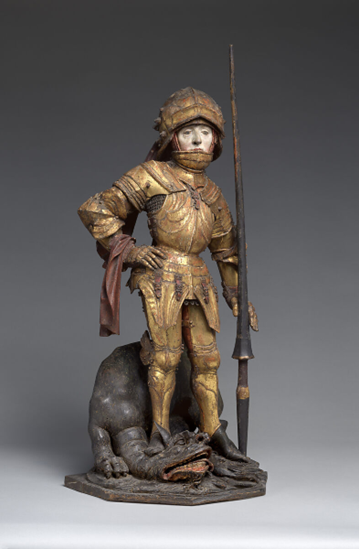
A man stands victorious over a mighty dragon, but just who is this man you might be wondering? The man that you are looking at is the revered Christian saint, Saint George, also known as George of Lydda. He is one of the earliest known Christian martyrs, who chose death over renouncing his faith. In this statue, which was created in the mid to late fifteenth century in modern day Germany, we see Saint George standing triumphantly over what appears to be a dragon. This statue coincides with the well known legend that tells the story of Saint George saving the town of Silene from a dragon.
In the famous legend, Saint George uses a lance to strike down the dragon, and in this statue, we can see that Saint George is holding a lance in his left hand, with his right hand placed on his hip posing victoriously over the dragon. His right foot is placed over the neck of the dragon, showing his victory over the creature in combat. Saint George is clad in gold armor, which due to its age has grown to look more rough and aged, in its prime, the sheen of the armor would have been a gleaming sight to behold. This gold color was chosen intentionally as gold is used to show George’s status as a saint. Saint George is an excellent example of early Christian martyrdom, but his legend of defeating a dragon in combat, is one of the everlasting legends of his life.
Blog Post:
The story of Saint George is one of the most well known of all the Christian saints of the medieval world. His legend combines that of heroism and faith. According to the legend, George was a knight from the region of Cappadocia, which is located in the modern day country of Turkey. In the legend, George was said to have saved the city of Silene in Libya from the terror of a deadly dragon. To keep the dragon at bay, the people of the Silene had resorted to sacrificing animals, and eventually their own children. One day, the king’s daughter was chosen to be sacrificed, but George intervened and confronted the dragon. He promised to slay the dragon if the townspeople converted to Christianity, which they agreed to, and so George killed the dragon and freed the people of Silene from its terror.
His legend then shifts to when he would become a martyr for the Christian religion as during this time, Christians faced intense persecution under Roman rule. George would refuse to renounce his faith, and so he would be faced with brutal torture, poison, attempts at execution, and other varies forms of punishment from the Romans that all failed to break him. Despite all of this, George never renounced his faith, and this would continue until he was ultimately executed. After his death, his legacy only grew through stories of miracles, relics, and even visions of him aiding Christian armies into battle. Over time, George would become a powerful symbol of courage and faith, especially in medieval Europe, where he would be honored as a patron saint and a model of chivalry. This is where the legend of Saint George would come to be known as the stories of his enduring faith and defeat of a mighty dragon showed his courage and unyielding faith.
The legend of Saint George, as well as his defeat of a dragon was a legend that persisted in the mind of those in medieval Europe for centuries. Many pilgrims and travellers would create different ways to honor Saint George, one such way was by creating statues of him and his defeat of the dragon. One such statue was found in Germany, and was likely made in the mid-15th century. The statue is made from wood and is painted over with gold, most likely to highlight his status as a saint. This was just one of many ways that Saint Geroge was honored by many medieval Europeans who looked up to him for guidance or inspiration.
Saint George’s legend is one the most famous legends of medieval Europe. From his slaying of a mighty dragon to his refusal to renounce his faith despite constant torture shows how medieval Europeans wanted to show how good would always triumph over evil, or in this case a dragon. His status as not only a saint, but also a martyr moved medieval Europeans in such a way that his story and life endured for centuries though works of art or stories reciting his life.
Bibliography:
Primary Sources
[The Metropolitan Museum of Art],[Medieval Art and The Cloisters]. SAINT GEORGE AND THE DRAGON. ca. 1460-1470. http://metmuseum.org/art/collection/search/467786. Accessed February 19, 2026.
Fordham University. Internet Medieval Sourcebook: The Golden Legend: St. George. https://sourcebooks.fordham.edu/basis/goldenlegend/GL-vol3-george.asp (accessed February 19, 2026).
Secondary Sources
Grotowski, Piotr. “The Legend of St. George Saving a Youth from Captivity and its Depiction in Art.” Series Byzantina 1 (2003): 27-77.
Morabito, Pasquale Maria. “Saint George and the dragon: Cult, culture, and foundation of the city.” Contagion: Journal of Violence, Mimesis, and Culture 18, no. 1 (2011): 135-153.
Morgan, Giles. St George: Knight, Martyr, Patron Saint and Dragonslayer. United Kingdom: Pocket Essentials, 2017.
Leave a Reply