By Alexandra Briggs
Transcript:
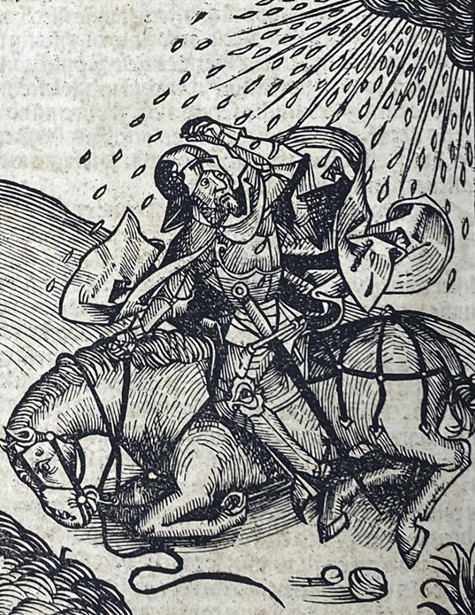
In Germany, 1493 marked the printing of a book that has fascinated generations: the Nuremberg Chronicle—326 leaves, roughly 18” x 12” in size, created to record the full history of the world. In large part, the Chronicle retraces the biblical narrative as world history, through both text and the use of “some 646 woodblocks over 1,800 times” (Voigt, 2). These woodblocks would have been drawn, cut, and inked by a team of around “four or five” medieval artists, including Michael Wolgemut, Wilhelm Pleydenwurff, and the renowned Albrecht Durer. (Stewart, 1-2, 4). One such woodcut, “The Conversion and Life of the Apostle Paul,” as translated in English, depicts just that.
Here, Saul—St. Paul, as he’s better known—experiences his famed revelation on the road to Damascus. Upright upon his collapsed horse, Saul shields his eyes against a light from heaven flooding in from the top righthand corner of the print. His expression is curiously serene, perhaps reflecting his being miraculously struck blind at that moment. Regardless, the intense action of this encounter is conveyed through the violent upturning of his cloak and the stark angle of his sword bisecting the lower half of the woodcut.
Yes, Saul, though a first-century Israelite in reality, in this piece, is depicted in European medieval knightly attire—sword and shining armor, his visor opened toward the heavenly light.
This woodcut visually modernizes its biblical narrative, and it does so in a highly culturally referential manner. Saul appears to be wearing a helmet and armor “typical” of “German horsem[e]n” during this period when compared to other prints of horsemen created by Durer; in fact, this print can be tied specifically to Nuremberg, as the city was a “leading center” for European “armor manufacture” at this time (Terjanian, 7, 15). In other words, these medieval artists have imbued “The Conversion and Life” woodcut with a personal connection to their native Nuremberg heritage and culture, a touchingly emotive expression of reverence toward the saints and the timelessness of God’s word.
But these artists weren’t alone. The desire to obtain personal closeness with biblical figures and narratives, even at the expense of historical accuracy, was quite common to medieval Christians on the whole. Many participated in forms of emotive meditation on scripture, such as the teachings of the Meditaciones vita Christi, which encouraged one to mentally “insert himself or herself into [bible stories], as a witness or even a character” (Powell, 7). Others gained physical proximity to areas in which Jesus Christ and other Christian icons once lived and died by undertaking arduous religious pilgrimages, translating scripture into direct experience. Of course, projecting certain architectural, political, or cultural aspects of, say, first-century Jerusalem or Rome onto their medieval counterparts often resulted in anachronistic beliefs. Regardless, pilgrimage remained a deeply emotional and formative experience for many. In fact, in the case of female pilgrim Margery Kempe, the combination of meditation and pilgrimage to Jerusalem was said to have supplied her with miraculous visions.
As they went around, at all times the friars told them what our Lord suffered in every place. And the aforementioned creature wept and sobbed so plentifully as though she had seen our Lord with her physical eye, suffering His Passion at that time. Before her, in her soul, she saw Him truly by contemplation, and that caused her to have compassion… Before her face she heard and saw in her spiritual sight the mourning of our Lady, of St John and Mary Magdalene, and of many others who had loved our Lord.
From this context, what we might consider odd or distracting stylistic choices in illustrations like “The Conversion and Life of the Apostle Paul” in the Nuremberg Chronicle are better understood as microcosms of the larger attitude and traditions of fifteenth century Christendom. Seamlessly blending biblical narrative with what was then contemporary and regionally specific dress, this woodcut is more than a breathtaking product of intricate craftsmanship—it’s a testament to the late medieval pursuit to unify one’s existence with those of the heroes of the faith.
Bibliography:
Primary Sources
Margery Kempe, The Book of Margery Kempe, 1st ed. Anthony Bale (Oxford University Press, 2015), 63-72.
Wolgemut, Michael, and Wilhelm Pleydenwurff. “Conversio et vita Paul ap[ostol]i.” 1493. Woodcut. University of North Texas Special Collections, Denton. In Registrum huius operis libri cronicarum cu[m] figuris et ymagi[ni]bus ab inicio mu[n]di. By Hartmann Schedel, 103. 1493.
Secondary Sources
Powell, Raymond A. “Margery Kempe: An Exemplar of Late Medieval English Piety.” The Catholic Historical Review 89, no. 1 (2003): 1–23. http://www.jstor.org/stable/25026320.
Stewart, Alison G. “Early Woodcut Workshops.” Art Journal 39, no. 3 (1980): 189–94. https://doi.org/10.2307/776352.
Terjanian, Pierre. “PRINCELY ARMOR IN THE AGE OF DÜRER: A RENAISSANCE MASTERPIECE IN THE PHILADELPHIA MUSEUM OF ART.” Philadelphia Museum of Art Bulletin, no. 5 (2011): 1–54. http://www.jstor.org/stable/41501095.
“The Nuremberg Chronicle.” The Library of Congress. Accessed March 6, 2026. https://www.loc.gov/item/2021666735/.
Voigt, Lisa and Elio Brancaforte. “The Traveling Illustrations of Sixteenth-Century Travel Narratives.” PMLA 129, no. 3 (2014): 365–98. http://www.jstor.org/stable/24769475.
Leave a Reply