By Jacob Fuentes
Transcript:
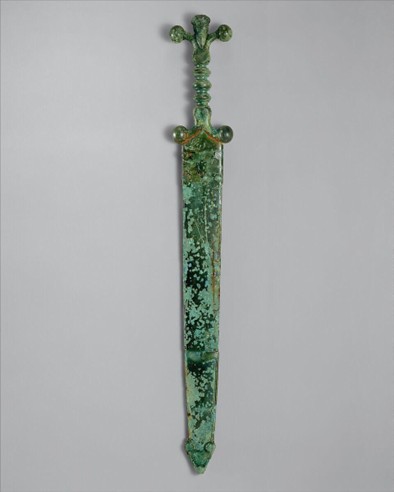
The sword you gaze upon gleams directly back at you despite the Jade of oxidation layering the weapon in its entirety. The sword is around 19 inches long, with the hilt being the defining detail, the figure of a man with almond eyes and defined hair that can evoke the spirit of a warrior. The sword itself was found at an important Celtic site on Lake Neuchâtel in present-day Switzerland and eastern France that is associated with the La Tène culture.Thus the question be asked: Who were the people who inhabited the most distant lands of Europe? Most accounts of the ancient Celts come from second-hand sources from the polities that fought against them, such as the Romans. In contemporary times, the image of the ancient Celts is filled wth a certain mystique; the ancient Cetls are portrayed as a spiritual people living far away from “civilization,” sometimes possessing supernatural powers, almost living as a wild people. However, I seek to truly understand the ancient Celts by learning about their history, art, and folklore
Lets delve into the most well known piece of of celtic literture the epic known as The Tain Bo Cúailnge.It details how Queen Medb of Connacht’s invasion of Ulster to steal the Brown Bull of Cooley, defended by the hero Cúchulainn.
The central themes of the Tain include heroism,honor and the dangerous of ambition.
The warrior Cuchulainn faces warrior after warrior until he has to confront the his best friend who is fighting with the opposition, and thus the themes of honor and loyalty are explored. In the end Cuchulainn ends up killing his best friend,Queen Medb uses the distraught hero as an advantage to successfully takes the brown bull. The brown bull is then forced to fight a white bull, in which the brown bull kills the white bull mirroring cuchulainns struggle.
The tain provides deep insight into how celtic society operated and the moral values people valued,notably the role of a warrior.
Now in compersion to a real world account,specifcally that of Gerald of Wales: The Norman Conquest of Ireland. Portrays the political structure that is outlined in the Tain but most impartotant the spirit of resistance of the irish celtic population. It is an account thatr reinforces how warrior culture was so deeply ingrained.
The ancient Celts were a people defined by a paradox: they were capable of creating delicate, transcendent art while living a life of brutal, endemic warfare. The Táin Bó Cúailnge offers us the interior life of the Celt heir fears of betrayal, their reverence for the land, and their tragic dedication to honor. Conversely, the accounts of Gerald of Wales provide the exterior view—a people whose “wildness” was actually a sophisticated, decentralized form of social organization that resisted assimilation for centuries.
To hold the La Tène sword is to touch a culture that refused to be simplified. They were not “supernatural” beings from the mist, but a deeply logical people whose logic was rooted, the epic, and the edge of the blade. Their legacy is not found in crumbling stone empires, but in the enduring power of their stories and the stubborn spirit of the “distant lands” they called home.
Bibliography:
Primary Sources
Sword and Scabbard, Celtic, ca. 60 BCE, Iron blade, copper alloy hilt and scabbard, The Metropolitan Museum of Art, New York, Object Number 1999.94a-d https://www.metmuseum.org/art/collection/search/470298
Primary text:
Gerald of Wales: The Norman Conquest of Ireland (12th Century) https://sourcebooks.fordham.edu/source/geraldwales1.asp
Secondary Sources
Campbell, J. B., and Lawrence A. Tritle. 2013. The Oxford Handbook of Warfare in the Classical World. Oxford: Oxford University Press.
Cunliffe, Barry W. 1997. The Ancient Celts. Oxford: Oxford University Press.
Megaw, J. V. S. 2014. Celtic Art in Europe: Making Connections. Essays in Honour of Vincent Megaw on His 80th Birthday. Edited by Chris Gosden, Sally Crawford, and Katharina Ulmschneider. Oxford: Oxbow Books.
Leave a Reply