by Hannah Derr
Transcript:
The Vikings were a people known primarily for their overseas travel. They created impressive vessels that served a variety of purposes such as raiding, trading, and even burial. Their vessels varied in size, but often featured a singular, large sail, a similar broad shape, oars, and a raised mast. Yet, our records show an impressive diversity in the construction of these great ships, as well as a strange inconsistency.
The Viking ship is one of the most iconic images of those ancient seafaring people and yet there is much that we do not know about them. Primarily, we lack detailed information regarding the large sails believed to be used on most Viking vessels. We know that many Viking ships possessed a sail, due to surviving illustrations and logical deduction based on the distance we know they traveled. Although some Viking vessels have been recovered and maintained in fair shape, we do not have any original sails, leaving historians to have to guess as to their size and material. According to Vibeke Bischoff’s article “Viking-Age Sails: Form and Proportion,” one excavated Viking ship was found with a piece of wool textile, believed to have been part of the sail. David Shaw, in his article, “Secrets of the Viking Ships,” says that the sails were stated to be made of wool in the sagas. Although the sagas were not strictly factual, it does add credibility to the theory. Shaw also suggests that the wool may have had walrus hide sewn in to preserve the strength and flexibility of the sails. Bischoff discusses multiple excavated Viking ships in depth. Two of these ships, The Gokstad and Skuldelev 3, were built over 200 years apart, yet both have masts, suggesting the use of sails. Although many Viking ships appear to also utilize oars, Shaw points out that prolonged use would exhaust the Viking sailors. It is clear then, that sails were in fact a staple of Viking ship construction.
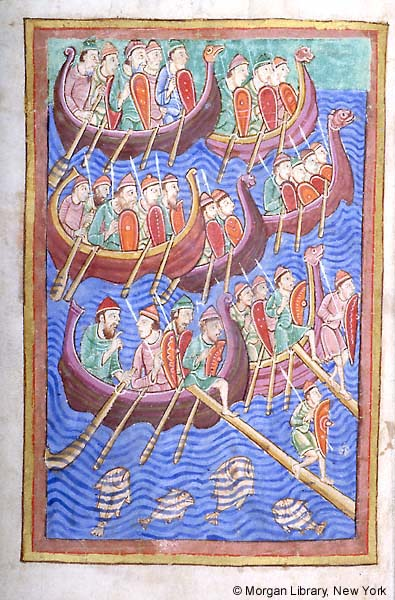
It is odd then, that the British manuscript, known as “The Life and Miracles of St. Edmund”, features a host of ships, all without a mast or sail. The illustration depicts seven Viking vessels each containing 3-5 colorfully dressed Vikings. The ships appear to be long and thin and there are animalistic figureheads on the on the bows. The seas appear to be somewhat rough, indicated by the squiggly lines representing the shape of the waves and the tilted orientation of a few of the vessels. Most of the men are holding spears and shields. There are oars in the hands of the men sitting aboard the vessels. Some appear to be boarding some kind of plank, presumably to get to shore. We can tell from their weapons and their stances that they are preparing to battle. It is clear that the raiders depicted are Vikings judging by the appearance of the ships and as identified by the Index of Medieval Art, so it is unclear why these vessels are missing such key components of their ships. Kim Hjardar in his book, “Vikings: Raiders From the Sea”, claims that sails would have been commonplace technology for Nordic sailors during the mid-8th century, meaning that the Viking invaders would have been using them during 1130 when the manuscript was produced. Perhaps the illustrator purposefully left the sails out of their illustration to manipulate the appearance of the Vikings to seem simpler and more primitive. Certainly, the invaded were struck with fear when they saw the intimidating ships approaching, as described by Zuhrī in “Ibn Fadlān and the Land of Darkness”, who stated that “they were big ships with square sails… when they attacked the coastal peoples fled for fear of them.” Zuhrī’s account comes from 1160, not long after the manuscript was produced and in a different place in Europe. Evidently, the image of the Viking ship was well known, and heavily feared, at least in coastal areas.
Bibliography:
Primary Sources
Primary Source Object: The Index of Medieval Art. “Work of Art”. Accessed February 13, 2026. https://theindex.princeton.edu/s/view/ViewWorkOfArt.action?id=20B8D561-2B31-40F0-BA00-CE8FEDE36CC4
Primary Source Text: Ibn Fadlān, Ibn Fadlān and the Lands of Darkness, trans. Pail Lunde & Caroline Stone. Penguin Classics 2012 (110)
Secondary Sources
Hjardar, Kim. Vikings: Raiders from the Sea. Casemate, 2017. ProQuest Ebook Central.
Bischoff, Vibeke. “Viking-Age Sails: Form and Proportion.” Journal of Maritime Archaeology 12, no. 1 (2017): 1–24. https://doi-org.libproxy.library.unt.edu/10.1007/s11457-016-9167-2
Konstam, Angus. Historical Atlas of The Viking World. Checkmark Books, 2002.
Shaw, David W. , 2016. “Secrets of the Viking Ships.” Scandinavian Review, Autumn, 6-21. https://libproxy.library.unt.edu/login?url=https://www.proquest.com/magazines/secrets-viking-ships/docview/1851646534/se-2
Leave a Reply