By Shea Busby
Transcript:
Speaker 1 (00:00)
Where do you keep your money? If you are like me, you know you keep it in a bank account. But five hundred years ago, during the 15th century, you would not have a bank account at least most people when it banks weren’t really a thing you had money lenders, but not really banks.
Speaker 1 (00:15)
So you had nowhere to keep it, but on your person or in your house. So if you want to go shopping, what do you have to do? Well, they didn’t have paper money back then.
Speaker 1 (00:24)
They didn’t have the internet so they weren’t doing like, you know, Venmo. The only options without paper money or Venmo coins can’t carry coins around in your hand send prayatuhole or hard to carry, he might drop something can’t open doors. So you put them in a purse, which feels a little obvious to say, but for some reason, we don’t think about purses anymore, which I think is a shame because everyone’s carrying around a bag or a wallet.
Speaker 1 (00:51)
The purses are cool. Purses are very, very cool, but they’re so practical, and they’re practical, and so we don’t think about them which I think is a shame if you go into the metropolitan museum in New York, they have this. It’s owned on display.
Speaker 1 (01:09)
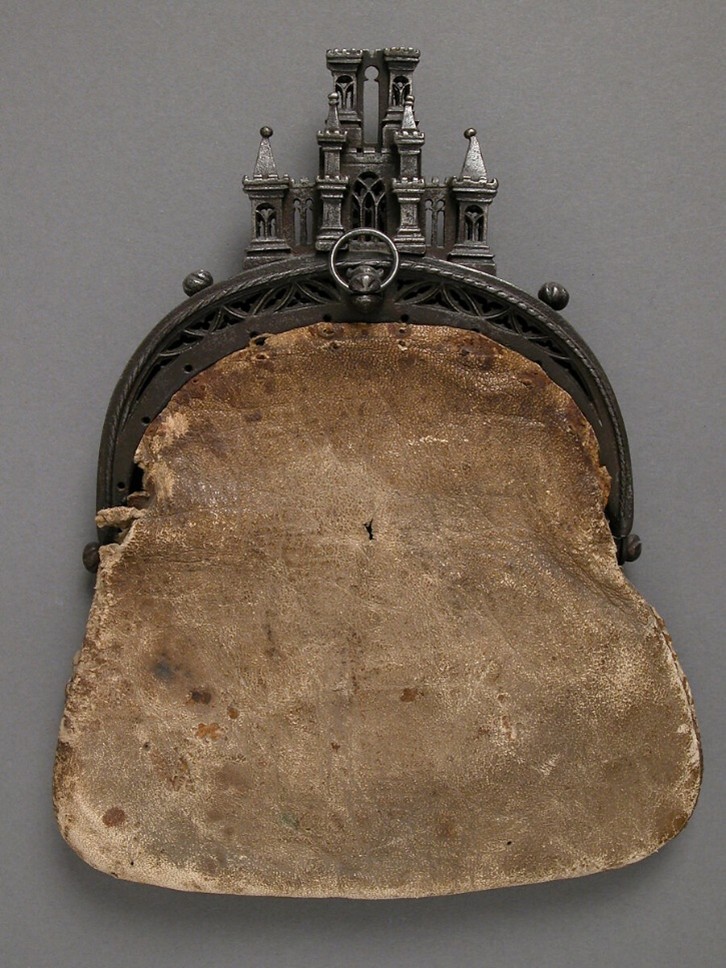
But in their archives, they have this purse. They have leather purse and it’s beautiful, not the leather, but the metal work on top. It’s not very big, but it has 2 bigger compartments.
Speaker 1 (01:26)
And then 2 smaller compartments, which are just so cool, they’re very, very cool. And then the metalwork on top The amount of work is amazing. It is this.
Speaker 1 (01:40)
It looks silvered me, so I’m calling it silver. Where it looks like a church or maybe a castle? But I’m leaning towards church, and then it has hoops on it.
Speaker 1 (01:51)
So you can attach it to your belt, and it’s so practical, and it’s so beautiful and just you have to have something and you have to have money. And there’s not a lot we know about this purse. On the webs from the metropolitan museum, it’s just labeled perse 15th to 16th century.
Speaker 1 (02:14)
That there’s not a lot on it. We have the archival record. We have the number it’s not even displayed.
Speaker 1 (02:21)
Probably because the leathers and terrible condition But so it’s so interesting to look at things like this. Because they’re the typical everyday things that just remind you of how human humans have always been. Where you have to go, buy groceries.
Speaker 1 (02:40)
So you have to put your money somewhere. So mine had a purse.
Blog Post:
Long before we had Tap-to-Pay, credit cards, or even paper money, everyone used coins. And as everyone who has ever had to deal with coins knows, just carrying them in your hand is both bad for keeping track of your money, and you lose the ability to use your hands. Which leaves only one practical option: bags!
Body 1 background: The history of bags goes back forever, and I am only slightly exaggerating. But if people have had uses for bags we have wanted to decorate our bags. An example that I love that can be found at the Met in New York city is a 15-16th century leather coin purse with an intricate meatal closure in the shape of ether a castle or a church but I am leaning towards church. The purse has two bigger pockets and on the underside sown onto one of the larger pockets is two smaller pockets .: I unfortunately cannot tell you about the history of the purse itself even though I would love to But the Met Messum has very little on the purse and It is terrible history to make things up. LOL anyway the history of both leather making is deeply fascinating but personally deeply horrifying. I read a book or the beginnings of it anyway that talked about the leathering process and I was just to grossed out too look more into it, what can I say I have a week stomach. But if you have interest I mean just look at this piece of both history and art, I simply adore crafts and all they can tech us about the times, people, and practicalities .

Bibliography:
Primary Sources
Purse, 15th-16th century. Iron, Leather, Overall: 9 x 7 1/16 x 1 5/8 in. (22.9 x 17.9 x 4.1 cm) purse clasp only: 5 x 6 x 1 5/8 in. (12.7 x 15.2 x 4.1 cm). The Met, New York City. 52.121.2. https://ww,.w.metmuseum.org/art/collection/search/468378Links to an external site.
Both images used are within public domain and come from this website.
William Wey, The Itineraries of William Wey, fellow of Eton college. To Jerusalem, A.D. 1458, and A.D. 1462; and to Saint James of Compostella, A.D. 1456. From the original manuscript in the Bodleian library; The internet Archive; Cornell University Library; 20 February 2026
Secondary Sources
Waterer, John W. “A Novel Method for the Conservation of Fragile Leather.” Studies in Conservation 17, no. 3 (1972): 126–30. https://doi.org/10.2307/1505503.
Bardsley, Virginia Owen. “Medieval Baggage: What the Fourteenth Century Traveler Carried: Part I.” The Mississippi Quarterly 9, no. 2 (1956): 56–72. http://www.jstor.org/stable/26473461.
Drumm, Colin. “15: Money is a thing: coins and bills in late medieval Europe”. In Research Handbook on Law and Political Economy, (Cheltenham, UK: Edward Elgar Publishing, 2025) accessed Feb 20, 2026, https://doi.org/10.4337/9781803921198.00025
Leave a Reply