By Grayson Dalferes
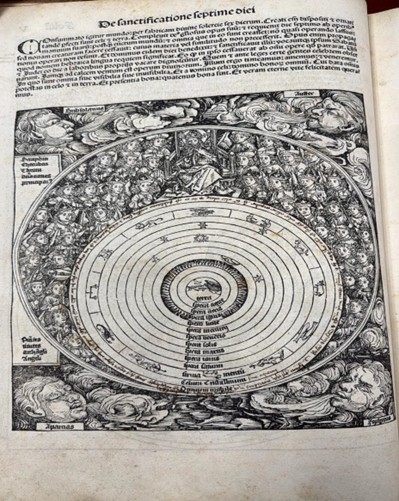
Transcript:
Good morrow, podcast travelers! Welcome to Medieval Travelers. The podcast that takes you on a wondrous journey back in time to explore the beauties of the Middle Ages. Travel during this era was more than just about your destination awaiting your arrival; it was a test of true courage, commitment, and wisdom, guided by maps, stars, and local knowledge. Today, we explore a remarkable example from the oldest known encyclopedia, the Nuremberg Chronicles, that demonstrates how Medieval Travelers admired yet comprehended their surroundings.
The Nuremberg Chronicles, written by Hartmann Schedel in 1493, offers one of the most amazing glimpses of medieval travel. Rather than documenting historical events, this highly illustrated volume reflects a growing interest in the larger, distant places of the world, featuring elaborate maps of Europe, Asia, and Africa. When looking deeper into the context, we begin to see that physical travel was more than just moving across land. It was closely associated with intellectual and spiritual advancement; it involved an in-depth study of faith, knowledge, and the world at large.
As we delve deeper into the book, we come across a page on Folio V. The Latin text, based on the biblical account in Genesis, states that God rested on the Seventh Day after creating the “finished, ordered, and adorned” Earth, through the work of wonder and divine power. Beneath the text, the Ptolemaic System can be found, with the Earth at the center of a series of circular spheres that include the sun, the moon, the planets, and the zodiac signs, which all made a universe full of divine order and time, all set within a crystalline sky. Because celestial movements were thought to affect daily life, medieval travelers relied heavily on the stars, planets, and zodiac positions for guidance, timing, and safety during lengthy voyages. This worldwide view heavily
influenced Medieval Astronomy and Astrology. When combined, they show how the sky
became a reliable guide for travel and the reflection of God’s eternal purpose in life for humankind.
At the end of today’s episode on Medieval Travelers, we have taken a journey to the Nuremberg Chronicle’s Folio V, “On the Sanctification of the Seventh Day,” and examined how medieval Europeans linked travel, faith, and the universe. Planets, constellations, and the zodiac signs all represent elegant and divine harmony in the universe that God has organized, according to the text and artwork, as the strength, faith, support, and guidance of a navigational aid depicted by spiritual meaning at the heart of travelers.
Bibliography:
Primary Sources
Denton, Texas, University of North Texas Willis Library, The History Department/Special Collections. “The Seventh Day of Genesis: God and Angels Looking at the Universe,” Folio V, The Nuremberg Chronicles, Hartmann Schedel, 1493.
“Full Text of HARTMAN – Nuremberg Chronicle Translated in English.” Internet Archive. University of Wisconsin, Accessed March 15, 2026.
https://archive.org/stream/NurembergChronicleTranslatedInEnglish/Nuremberg%20Chr onicle%20translated%20in%20English_djvu.txt
Secondary Sources
Schmitz-Esser, Romedio. “Travel and exploration in the Middle Ages.” Handbook of Medieval Culture: Fundamental Aspects and Conditions of the European Middle Ages 3 (August, 2015): 1680-1704.
Chicago, Illinois, The University of Chicago Press, The History of Science Society. “Theory and Observation in Medieval Astronomy,” Isis Journals, Bernard R. Goldstein, March 1972. https://www.jstor.org/stable/229192
Carey, Hilary M. “Astrology in the Middle Ages.” History Compass 8, no. 8 (August,2010): 888-902. https://compass.onlinelibrary.wiley.com/doi/full/10.1111/j.1478-
Leave a Reply